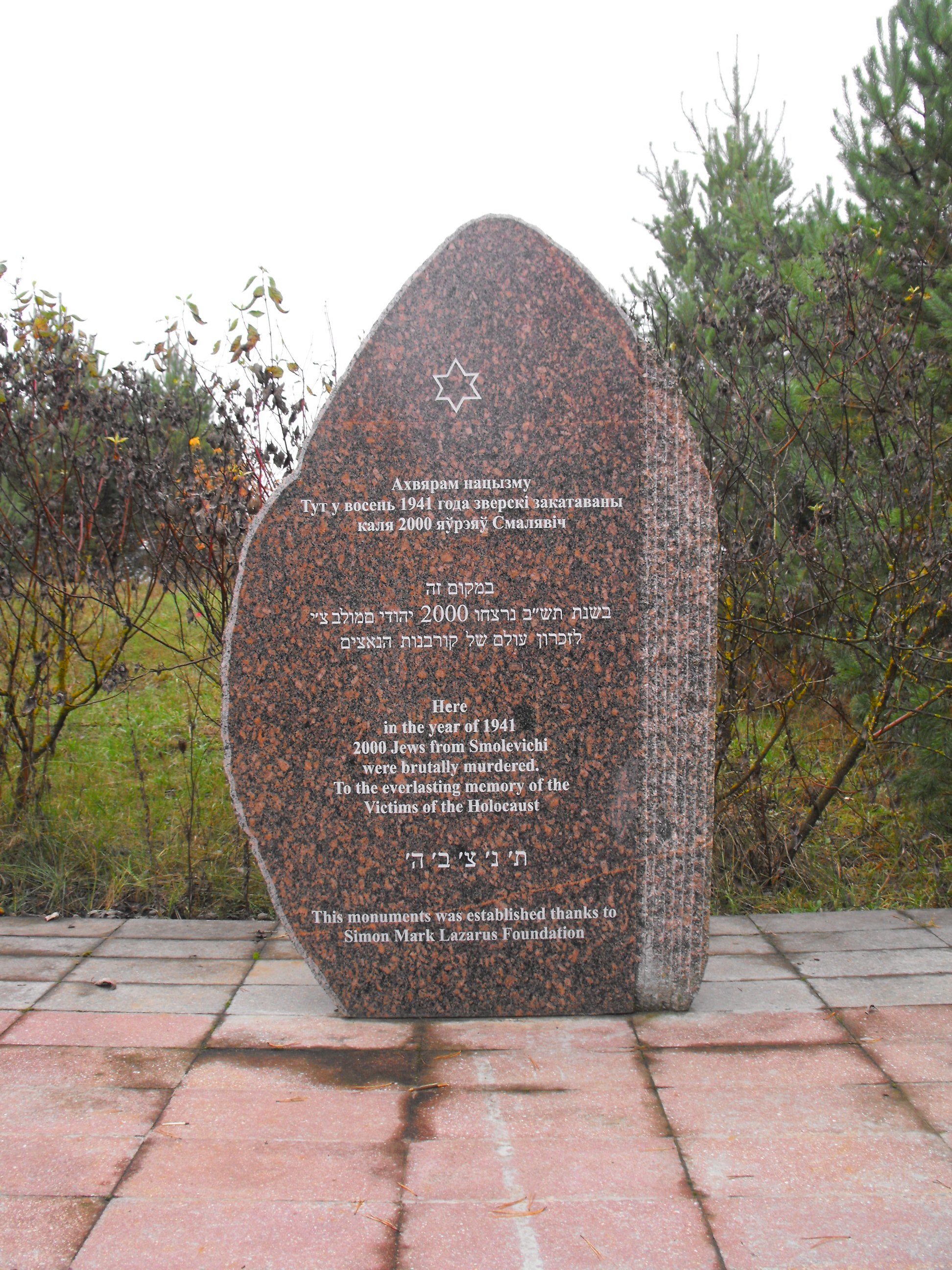


Smolevichi (or Smolevichy) #1
“Lev P., born in 1929: ‘One day we were grazing cows in the forest with my friends. Suddenly we heard screaming and gunfire coming from about 150-200 meters away. Then we saw the column of Jewish men being led to the site of the gunfire. They were being escorted by Germans with German shepherds. We learned later on that the women and children were the first to be killed and then the men. On another day, I saw a column of women, elderly people and children. They were being led to the hill. The execution lasted the entire day. The villagers said that only two people managed to escape.’ (Witness n°939, interviewed in Smolevichi, on August 5, 2017)” (“Execution of Jews in Smolevichi (Smalyavichy, Smolewicze, Smolewitsch), Minsk, Belarus.” Yahad–In Unum: The Map of Mass Shootings, Yahad–In Unum)
“‘[…] On the Gorodishche (Koplitsa) hill, 2 km south of Smolevichi, we have found four mass graves in which, in the period from August 19 to October 4, 1942, German-fascist invaders shot and buried 4,100 people, including 3,300 Jews and 800 prisoners of war and other civilians.During the German occupation the entire Jewish population of the town was gathered in a place called the “ghetto” which was surrounded with barbed wire. Their belongings, clothes, food and furniture were confiscated by the German authorities. For about a month, the German-fascist occupiers mistreated the Jews by making them sleep outdoors and depriving them of food. Many Jews were shot in the ghetto. On August 28, 1941, 1400 Jews: the elderly, women with children, and adolescents, were driven in columns out of the ghetto, under the pretext of resettlement to another location. […] The Jews were taken to Gorodishche hill where a pit had been dug in advance. Once at the site, they were stripped down to their underwear, led inside the pit and shot with automatic weapons. A large number of children were thrown inside the pit and buried alive. In the autumn of the same year 1941, on Gorodishche hill, 1,000 Jews and 106 prisoners of war were shot in the same way. […] In 1944, the German-fascist invaders opened the pits on Gorodishche hill and burned the bodies in order to erase the traces of their crimes. […]’ [Act drawn up on September 25, 1944 by the State Extraordinary Commission (ChGK); RG 22.002M: 7021-87-14]” (“Execution of Jews in Smolevichi (Smalyavichy, Smolewicze, Smolewitsch), Minsk, Belarus.” Yahad–In Unum: The Map of Mass Shootings, Yahad–In Unum)
“‘[…] We arrived at the Market Square and saw between twenty to thirty Jews with shovels and hooks. As usual S. had previously ordered the village chief to set up this labor group. This group of men left the village, turned left, and came to a forest. We followed them in our vehicles. […] When the Jews arrived at the forest they had to dig a pit. Once the pit was dug, they were shot. I suppose they were killed with sub-machine guns. The Jews could not have known that they would be shot; otherwise they would not have come.One of the following days we went back to Smolevichi. […] When we arrived, most of the Jews were already at the square, watched over by the Wehrmacht. The Wehrmacht, the OD and our men took the Jews out of the village. Most of them were women and children. There must have been several hundred people. The execution site was located on a hill. From my post at the square I could not see […] the pit. I don’t know who conducted the shooting. It is possible that the Wehrmacht fired too. The victims in the square could hear the shots but could not see the execution. […]’ [Deposition of EK8 member, Willy K., drawn up in Cologne on Mars 1, 1963. B162-3291]” (“Execution of Jews in Smolevichi (Smalyavichy, Smolewicze, Smolewitsch), Minsk, Belarus.” Yahad–In Unum: The Map of Mass Shootings, Yahad–In Unum)